Key takeaways
- In continuous annealing, strip quality depends on whether the gas burners inside the radiant tubes are burning fully — but those burners are numerous and invisible.
- Traditionally the only check was workers inspecting tubes by hand during a half-month overhaul every six months — slow, and dangerous in a high-temperature, toxic-gas environment.
- By mining ion-current data already collected by the BCU system, a rules-plus-outlier-detection model detects three fault types — no flame, unstable flame, flame not shutting off — with no new sensors.
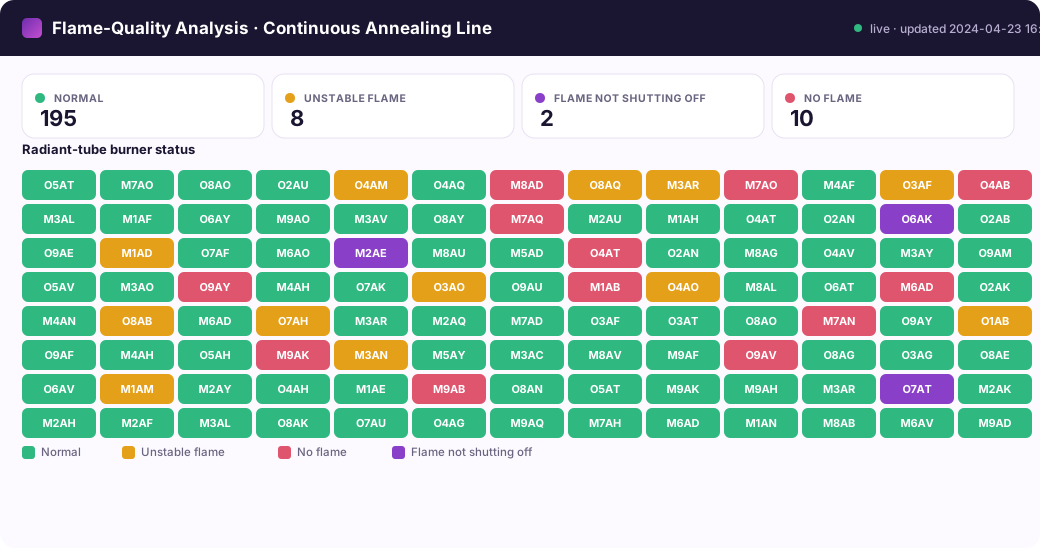
- On a line with 218 radiant-tube burner groups, manual six-monthly inspection became automatic remote checks roughly every two days, with alarms and precise fault location.
Cold rolling deforms steel heavily at room temperature, which sharply reduces the ductility and plasticity of the rolled sheet. To restore those properties the strip must be annealed — heated so that recovery, recrystallisation and grain growth release the locked-in stress. Annealing is therefore one of the most important processes in a cold rolling mill, and the quality of the finished strip depends directly on how efficiently it is annealed. That efficiency, in turn, comes down to one thing that is almost impossible to watch directly: whether the flames inside the radiant tubes are burning properly.
What is a radiant tube — and why is its flame so hard to monitor?
In a continuous annealing furnace the strip is heated indirectly. Gas burners fire inside sealed radiant tubes, and the tube walls radiate heat to the moving strip without combustion gases ever touching it. Each tube contains a large number of burners, and none of them is visible from outside. If a burner stops firing, burns unstably, or fails to shut off, the strip is heated incorrectly, its internal stress is not fully released, and both quality and throughput fall — yet nothing on the outside of the furnace shows it.
The pain point: an invisible, dangerous, once-every-six-months check
For a leading global steelmaker running a continuous annealing line, the only way to know how the burners were performing was direct human inspection. Radiant tubes were overhauled once every six months, and each overhaul took about half a month, with workers moving along the line and checking the working state of each tube with a handheld detector. The work was slow and low-yield — and it took place in a high-temperature environment full of harmful gases, so it carried real safety risk. Worse, because checks were so infrequent, an abnormal tube could go undetected for a long time, quietly damaging product quality and wasting energy in between overhauls.
The brief to Golden Data was simple to state and hard to deliver: build an information system that monitors combustion inside the radiant tubes, so the plant can inspect remotely, safely and efficiently — protecting strip quality and lifting productivity.
The key idea: mine the signal the burners already produce
The breakthrough was to avoid adding any hardware. Every burner already emits an ion current through the burner control unit (BCU) — a signal that reflects whether, and how steadily, it is burning. Rather than install new sensors or send people inside the furnace, the system extracts value from this existing data. As our DPlus® platform is designed to do, it collects the data, gives it engineering context, analyses it, and turns the result into an action — here, an alarm against a specific, named burner.
Three fault types, written into the ion-current signal
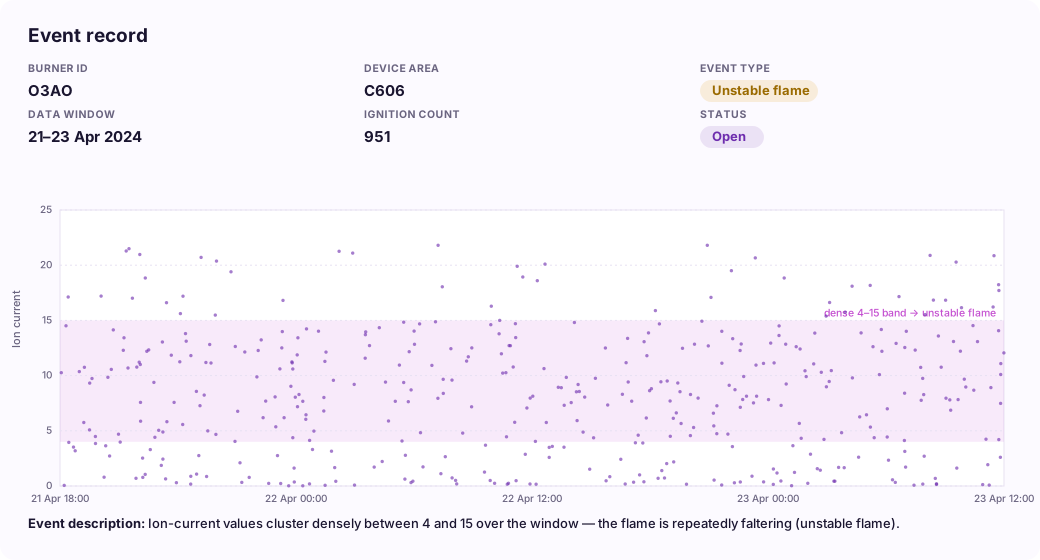
Working with the plant's combustion experts, the team engineered feature values from the ion-current data that describe combustion stability, then built an anomaly-identification model based on rules plus outlier detection. The model compares burners two ways: vertically (different burners over the same period) and horizontally (the same burner over different periods). It classifies three combustion events, each with a distinct signature in the data:
- Long-term no flame — the ion current stays at zero for an extended period (the burner simply is not lighting).
- Unstable flame — values cluster densely between the normal peak and zero, around the 4–15 band, showing the flame is repeatedly faltering.
- Flame not shutting off — the number of samples in the low 0–4 band rises abnormally, indicating the burner is not closing down when it should.
From signal to a working system
The model is wrapped in a web application that the plant's reliability team uses day to day, built around five functions: BCU alarm monitoring, event management, flame-quality views, analysis reports, and distribution (spectrum) analysis. Operators see the whole line at a glance — every burner colour-coded by status — drill into any flagged burner to read its ion-current distribution, and track events over time. In a representative run, the system tracked the line's burners every couple of days and logged a handful of genuine faults per check — typically around ten long-term-no-flame tubes plus a few unstable or not-shutting-off events out of more than two hundred burners — exactly the small, important signals that manual inspection used to miss for months.
What changed: O&M, production and energy
Operations & maintenance. A dangerous, twice-a-year handheld inspection became continuous, automatic monitoring with early warning. The system pinpoints exactly which radiant tube has failed, so engineers spend their time fixing rather than hunting — and nobody has to walk a hot, gassy furnace line burner by burner.
Production. Because faults are caught within days instead of months, the persistent quality problems, lost capacity and wasted raw material that come from a quietly failing burner are sharply reduced — and catching unstable combustion early also limits the equipment damage it can cause.
Energy. A batch of underperforming tubes makes the furnace heat up slowly or fall short of target temperature, which pushes operators to burn more fuel and feed in more energy. Spotting those tubes early cuts that excess consumption — a direct contribution to energy saving and emission reduction.
The takeaway for steel operators
The most valuable signal in a plant is often one you are already recording but not yet reading. Here, a current measurement that existed only to control a burner became, through feature engineering and a modest anomaly model, a remote and safe replacement for one of the most hazardous inspection jobs on the line. No new sensors, no rip-and-replace — just the plant's own data, turned into trusted, executable decisions.